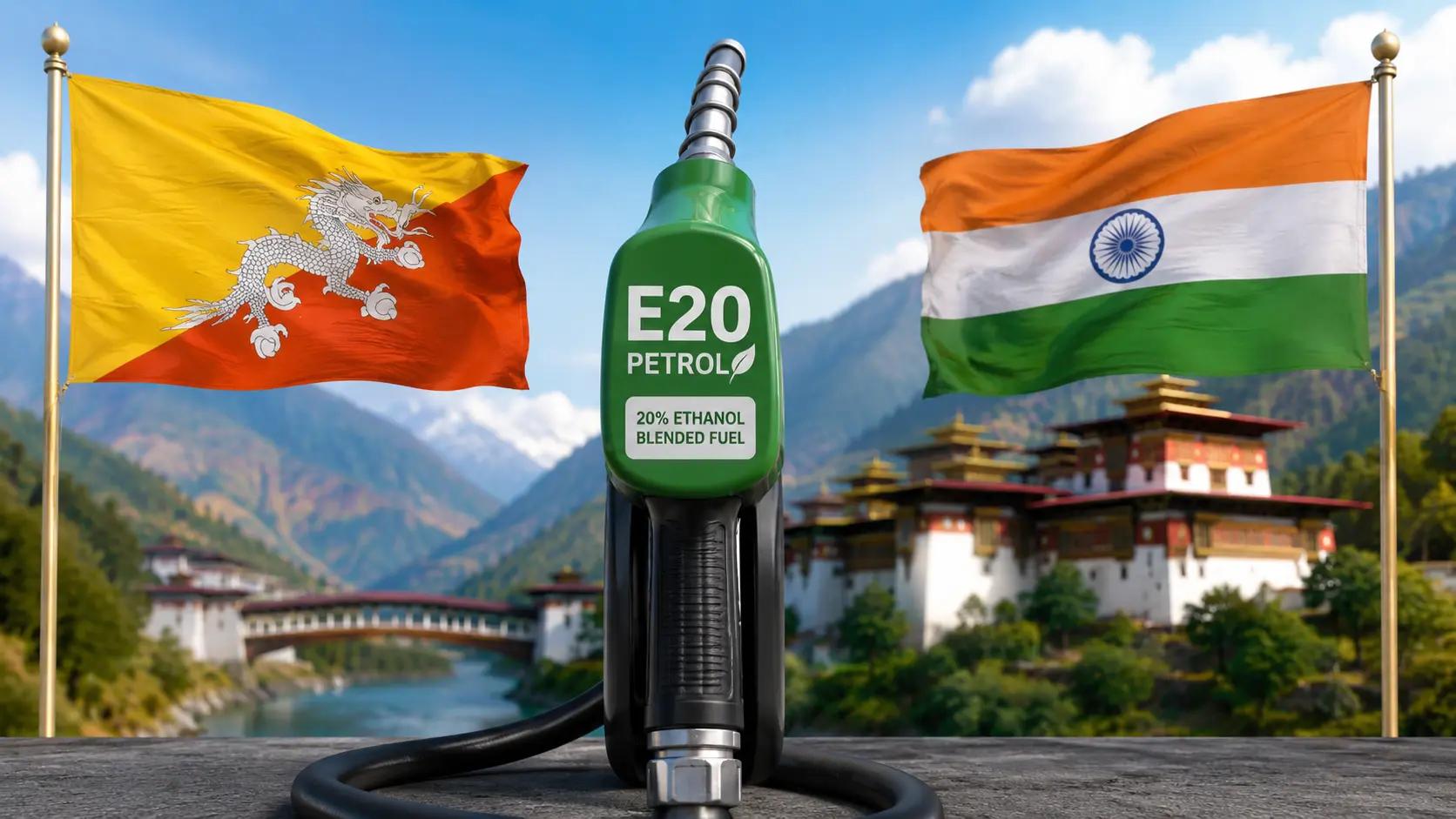
Bhutan Declines India’s E20 Petrol Offer: What It Means for the Future of Cleaner Fuels in South Asia
Bhutan Says No to E20 Petrol—for Now
India has been aggressively promoting cleaner transportation fuels as part of its ambitious green energy roadmap. One of the biggest milestones in this journey has been the introduction of E20 petrol, a fuel blend containing 20% ethanol and 80% gasoline. While the move has been widely adopted across India, neighboring Bhutan has decided not to switch to E20 fuel at this stage.
The decision has sparked discussions across the automotive and energy sectors, with many wondering whether Bhutan’s move signals concerns about ethanol-blended fuels. However, experts believe the country’s decision is based on technical infrastructure rather than doubts about the fuel itself.
Here’s everything you need to know about why Bhutan declined India’s E20 petrol offer and what this means for both countries.
What Is E20 Petrol?
E20 petrol is a blend consisting of 20% ethanol and 80% conventional petrol. Ethanol is a renewable biofuel primarily produced from sugarcane, maize, and other agricultural crops.
India has gradually increased ethanol blending over the past few years to:
- Reduce dependence on imported crude oil
- Lower carbon emissions
- Support domestic farmers
- Improve energy security
- Promote cleaner mobility
The Indian government has invested heavily in ethanol production infrastructure, making E20 one of the key pillars of its sustainable fuel strategy.
Why Did Bhutan Decline the Offer?
Bhutan’s decision has little to do with the quality or effectiveness of E20 fuel.
Instead, the country cited practical infrastructure challenges.
Many of Bhutan’s underground fuel storage tanks are older and were designed for conventional petrol. Ethanol has different chemical properties compared to regular gasoline, making storage conditions much more important.
One of ethanol’s key characteristics is that it readily absorbs moisture from the surrounding environment. If water enters aging storage tanks, the ethanol blend can become contaminated.
This contamination may lead to:
- Reduced fuel quality
- Engine performance issues
- Corrosion inside fuel systems
- Long-term maintenance concerns
Rather than taking unnecessary risks, Bhutan has requested continued supplies of conventional petrol until its storage infrastructure is upgraded.
Understanding the Science Behind Ethanol
Ethanol is known as a hygroscopic substance, meaning it naturally attracts and absorbs water molecules.
This property is beneficial in some industrial applications but requires extra care during fuel storage.
When excessive water mixes with ethanol-blended petrol, several issues can arise:
Phase Separation
The ethanol and water can separate from the petrol, creating two distinct layers inside storage tanks.
The lower layer contains water and ethanol, while the upper layer contains petrol with reduced ethanol content.
This affects combustion quality and engine efficiency.
Corrosion
Water mixed with ethanol can increase the possibility of corrosion in older fuel tanks, pipelines, and dispensing equipment.
Modern storage systems are specifically designed to minimize these risks.
Fuel Stability
Maintaining fuel quality becomes more difficult if storage facilities are outdated or poorly sealed.
This is the primary concern highlighted by Bhutan.
Is Bhutan Rejecting Green Fuel?
Not at all.
Bhutan remains one of the world’s most environmentally conscious countries.
The country is globally recognized for being carbon-negative, meaning it absorbs more carbon dioxide than it emits.
Hydroelectric power supplies most of Bhutan’s electricity, while forest conservation remains a national priority.
Its decision regarding E20 petrol is therefore viewed as an infrastructure issue rather than opposition to renewable fuels.
Officials simply want to ensure their existing fuel distribution system can safely handle ethanol-blended petrol before making the transition.
India’s Ethanol Success Story
India’s ethanol blending journey has accelerated dramatically over the past decade.
The country moved from very low blending percentages to achieving double-digit ethanol blending across many regions.
The government has encouraged ethanol production by:
- Increasing procurement prices
- Supporting ethanol distilleries
- Promoting flexible fuel vehicles
- Expanding distribution infrastructure
- Encouraging sugar mills to produce ethanol
These efforts have helped reduce billions of dollars in crude oil imports while providing additional income opportunities for farmers.
Are Indian Vehicles Ready for E20?
Most recently manufactured vehicles sold in India are designed or calibrated to operate with E20 fuel.
Automobile manufacturers have gradually updated engines, fuel pumps, injectors, seals, and fuel lines to ensure compatibility.
However, some older vehicles may experience:
- Slight reductions in fuel economy
- Rubber component wear over long periods
- Calibration differences
Manufacturers generally provide guidance regarding vehicle compatibility.
Infrastructure Matters More Than Fuel
Bhutan’s decision highlights an often-overlooked aspect of fuel transition.
Introducing cleaner fuels involves much more than producing the fuel itself.
Countries also need:
- Modern storage tanks
- Compatible pipelines
- Updated fuel dispensing stations
- Vehicle compatibility
- Quality monitoring systems
- Regular maintenance procedures
Without these supporting systems, even environmentally friendly fuels can face operational challenges.
Lessons for Developing Countries
Bhutan’s cautious approach offers valuable lessons for other developing nations considering ethanol-blended fuels.
Before switching nationwide, governments should evaluate:
- Existing fuel storage facilities
- Tank maintenance standards
- Water contamination risks
- Vehicle fleet compatibility
- Distribution infrastructure
- Fuel quality testing capabilities
A gradual transition often proves more successful than an immediate nationwide rollout.
Could Bhutan Adopt E20 in the Future?
Industry experts believe the answer is yes.
Once Bhutan upgrades its underground fuel storage systems and ensures adequate protection against moisture contamination, adopting E20 could become much easier.
As technology improves and infrastructure modernizes, cleaner fuels are expected to play an increasingly important role across South Asia.
Bhutan’s current decision should therefore be viewed as a temporary technical precaution rather than a permanent rejection.
The Bigger Picture
The discussion surrounding E20 petrol demonstrates that sustainability requires careful planning.
Cleaner fuels alone cannot achieve climate goals.
Successful implementation depends on:
- Engineering
- Infrastructure
- Policy coordination
- Vehicle technology
- Consumer awareness
- Quality control
India has already invested heavily in these areas, while neighboring countries may require additional time to modernize their fuel ecosystems.
What This Means for India
For India, Bhutan’s response is unlikely to slow the country’s ethanol blending program.
Domestic adoption continues to expand, and India’s long-term energy strategy remains focused on reducing fossil fuel dependence.
At the same time, Bhutan’s concerns may encourage fuel suppliers to consider infrastructure readiness when exporting ethanol-blended fuels to neighboring countries.
Customized solutions may become increasingly important as South Asian nations adopt cleaner energy technologies at different speeds.
Final Thoughts
Bhutan’s decision to decline India’s E20 petrol offer should not be interpreted as resistance to renewable energy. Instead, it reflects a practical assessment of its existing fuel storage infrastructure.
The move highlights an important reality: transitioning to cleaner fuels is not simply about producing environmentally friendly alternatives—it also requires compatible infrastructure, modern storage facilities, and careful implementation.
India’s ethanol blending initiative remains one of the country’s most significant clean-energy achievements, while Bhutan’s cautious approach serves as a reminder that every nation must balance sustainability goals with technical readiness.
As infrastructure improves across the region, E20 and other alternative fuels are likely to become more widely accepted, bringing South Asia one step closer to a cleaner and more energy-secure future.